Getting Student Feedback on Explicit Instruction
How do we know if we're hitting the mark?

First, an introduction to some terms: Load Reduction Instruction (LRI) is a teaching framework developed by Australian educational psychologist Andrew J. Martin, later refined with Paul Evans, to describe how effective explicit instruction deliberately manages students’ cognitive load as they move from novice to independent learner.
Grounded in cognitive load theory, LRI is not a new learning theory but a practical synthesis of well-established principles. Its central idea is straightforward: when students are first learning something new, teaching should reduce unnecessary cognitive demands through explicit instruction, modelling, and guided practice. As understanding strengthens, instructional support is gradually withdrawn, allowing students to take on more cognitive responsibility and work independently.
But how can a teacher know how effective they are at Load Reduction Instruction? Martin and Evans came up with the Load Reduction Instruction Scale (LRIS) as a means to get feedback on this. It could easily be used as a way to get feedback from students directly, or to have an experienced teacher observe your class using this scale.
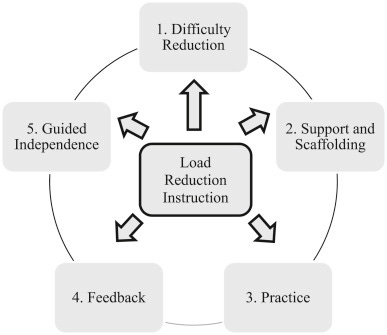
The scale is broken up into 5 sections, with 5 statements on each, which are then rated on a Likert scale. A simple and effective way to get a read on just how well you are managing these elements of reducing unnecessary cognitive load.
Read more here. The full LRIS can be found in the appendix of this article.